PDLC vs Electrochromic vs SPD: How to Choose the Right Switchable Glass Technology
PDLC switchable glass, electrochromic glass (EC), and suspended particle devices (SPD) are three mainstream dynamic glass technologies. When specifying smart glass for conference rooms, office partitions, or commercial spaces, the question comes up: What's the difference, and which one should I choose? This article breaks it down. STARTEK is a Taiwan-based PDLC switchable glass specialist, offering a complete product range and end-to-end service.
Key Facts
- PDLC switchable glass responds in under 0.2 seconds — power on for transparent, power off for opaque privacy; voltage adjustment also enables continuous dimming, so both PDLC and EC can address dimming needs
- Electrochromic glass transitions more slowly, primarily adjusting light transmission rather than providing frosted privacy (switching time and transmittance range vary by manufacturer)
- SPD smart glass offers variable tinting — dark when off, clear when on (response time and power characteristics vary by manufacturer)
- PDLC power consumption: approximately 5 W/m²
- STARTEK exterior PDLC (EX series) provides outdoor heat control and solar shading: 87% infrared heat rejection and 99% UV blocking (manufacturer data; varies by model), while still switching between clear and frosted
- STARTEK laminated switchable glass: 5-year standard warranty (included), extendable to 10 years
How the Three Technologies Work
PDLC (Polymer Dispersed Liquid Crystal)
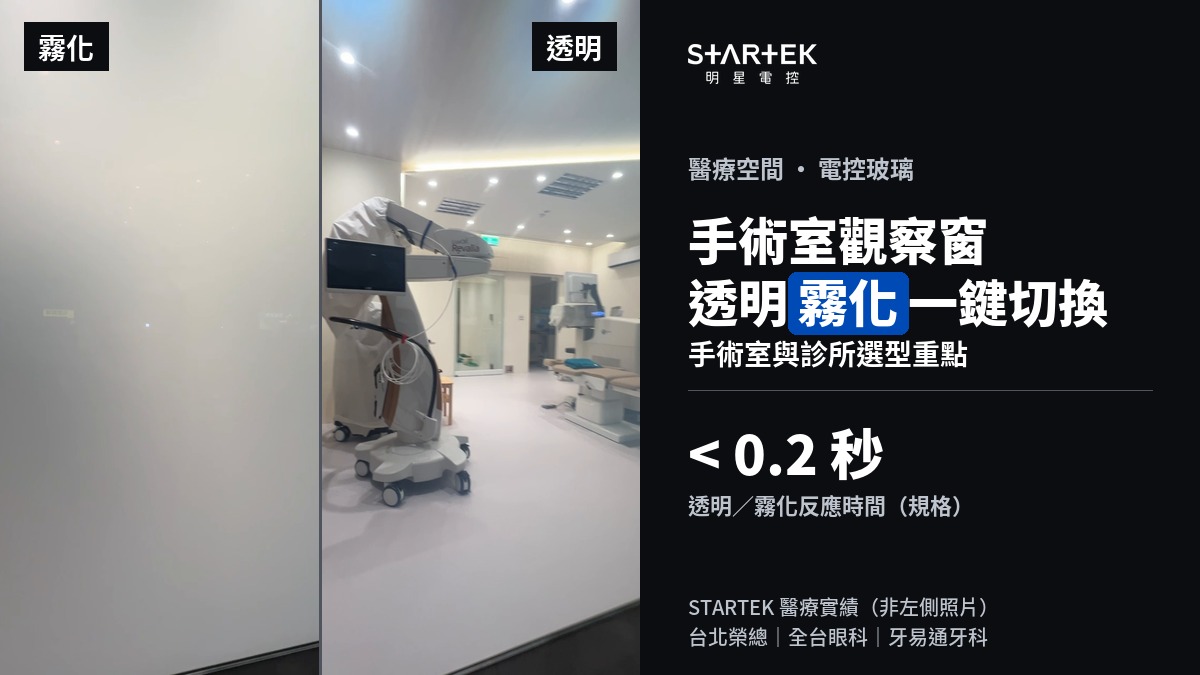
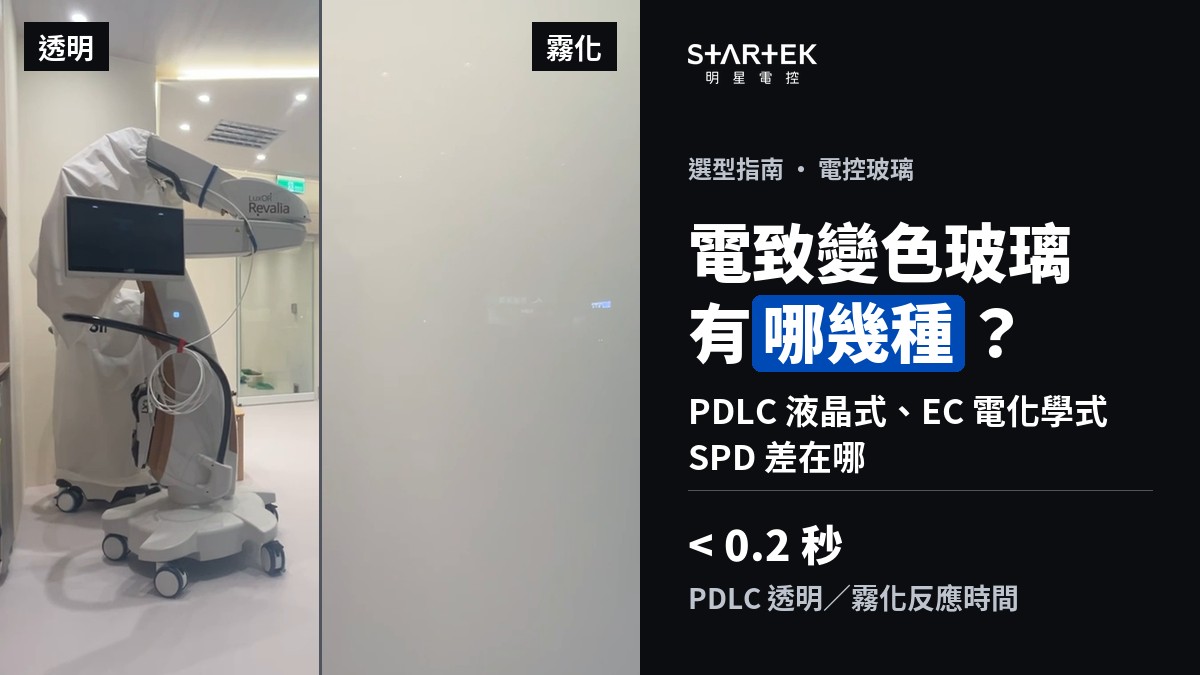
When power is off, liquid crystal molecules scatter light randomly, creating a frosted, opaque appearance. Apply power, and the molecules align — the glass turns transparent instantly. By adjusting the applied voltage, PDLC can also achieve continuous dimming — gradual light control, not just an all-or-nothing switch. It is the most widely used technology for indoor privacy switching, with dimming capability built in.
Electrochromic (EC)
An electrochemical reaction changes the optical properties of a metal oxide film within the glass, gradually shifting from clear to tinted. Its strength is solar heat management, commonly used on building facades and skylights.
SPD (Suspended Particle Device)
Nano-scale particles within a film align or scatter under an electric field, controlling light transmission. Dark when off, clear when on, with continuously variable tinting.
Five Comparisons That Matter for Designers
Since product specifications vary significantly across brands and generations, this article provides qualitative comparisons rather than brand-specific figures.
1. Response Time
PDLC switchable glass switches in under 0.2 seconds (transparent → frosted < 200 ms; frosted → transparent < 10 ms) — essentially instantaneous. Electrochromic glass transitions more slowly, suited to applications that do not require frequent switching. SPD falls between the two. (Exact switching times for electrochromic and SPD vary by manufacturer.)
2. Privacy Performance
This is where PDLC excels. When frosted, PDLC glass creates a uniform white opacity — you cannot easily see details through it (objects pressed within about 10 cm of the glass may still show faint outlines; maintaining distance behind the glass improves privacy). Electrochromic glass is designed for light control, not frosted privacy — even at its darkest tint, it remains transparent. Among the three technologies, PDLC is best suited for spaces that need on-demand visual privacy.
3. Light Transmission
PDLC switchable glass offers good transparency when powered on, with different color temperature options for different visual characteristics. Electrochromic glass generally has higher peak transparency but significantly reduces interior light when tinted. PDLC switchable glass also offers continuous dimming through voltage adjustment. SPD also offers variable tinting. In other words, for dimming needs, both PDLC and EC deliver. All three maintain natural daylight in their transparent state.
4. Power Consumption
PDLC switchable glass consumes approximately 5 W/m² and defaults to frosted (privacy) when powered off — zero standby power for the privacy state. Electrochromic and SPD have different power profiles (specifics vary by manufacturer). All three technologies are low-power; the key difference is which state draws power.
5. Application Fit
PDLC excels at instant indoor privacy switching — conference rooms, executive offices, medical facilities, display windows. Electrochromic glass is commonly used for facade solar management — curtain walls, skylights, solar shading. PDLC also has continuous dimming capability, so both technologies can address dimming needs. For outdoor heat control and solar shading, exterior PDLC (the STARTEK EX series) is also an option — well suited to exterior windows and window-side meeting rooms that need both heat control and privacy. SPD is typically found in transportation and specialty applications — aircraft windows, automotive sunroofs.
PDLC and Electrochromic Glass: Same Family, Different Jobs
PDLC switchable glass and electrochromic (EC) glass are both electrically switchable smart glass. The difference is how they change: PDLC uses liquid crystal alignment to switch between clear and frosted in under 0.2 seconds, and can also dim continuously through voltage adjustment; EC uses an electrochemical reaction to tint gradually, commonly used for solar control. For dimming, both PDLC and EC deliver — the difference is that PDLC also offers instant privacy switching.
All STARTEK products use PDLC technology — standard PDLC is transparent with power on and frosted with power off — delivering instant privacy switching.
Solar Shading: Exterior PDLC Is an Option Too
Outdoor solar shading is not only a job for electrochromic glass. STARTEK's exterior PDLC EX series (EX65, EXGR, EX30, EXBR, EX20) is an existing product line for exterior windows, providing heat control and solar shading while keeping clear/frosted privacy switching.
- Infrared heat rejection: 87% (film manufacturer's published specification; varies by model)
- UV blocking: 99%
- Solar heat gain coefficient (SHGC): 0.36 for EX30, 0.49 for EX20 — close to Low-E glass, yet still switchable to clear
- Exterior films are darker in tone and less clear than standard clear glass in the transparent state; tint, light transmission and heat performance vary by model
The difference from electrochromic is how the glass changes: exterior PDLC's core strength is fast switching with privacy frosting, and it can also dim through voltage adjustment; EC specializes in slow, gradual tinting for solar shading. If the brief is "block heat and shade the sun, with privacy at the push of a button", consider the STARTEK exterior PDLC EX series. If it is "large-scale gradual solar tinting", electrochromic is the closer fit. STARTEK recommends the model based on orientation and use on site.
Selection Guide: Start with the Space
Choose your smart glass technology based on what the space actually needs:
- Instant privacy switching (conference rooms, clinics, executive offices) → PDLC switchable glass
- Outdoor heat control and solar shading plus privacy (exterior windows, window-side meeting rooms) → STARTEK exterior PDLC (EX series)
- Dimming for solar and daylight management (large facades, skylights) → Both PDLC and EC offer dimming; EC is commonly used for large-scale gradual tinting, while the STARTEK exterior PDLC EX series can combine dimming with privacy switching
- Variable tinting with premium budget (specialty applications) → SPD
For the vast majority of interior design applications, PDLC switchable glass covers the need. STARTEK offers a complete PDLC product line — from warm 2800K to high-clarity 5000K for interiors, plus the EX series for exterior solar shading — in both laminated and retrofit installation options, with design support, installation, and warranty as a one-stop service.
FAQ
Q1: Which switches faster — PDLC or electrochromic glass?
PDLC switchable glass responds in under 0.2 seconds, essentially instantaneous. Electrochromic glass transitions more slowly; exact switching time varies by manufacturer.
Q2: Can electrochromic glass provide full privacy?
Electrochromic glass is designed for light control, not frosted privacy — even at maximum tint, it remains transparent rather than opaque. For on-demand visual privacy with a frosted effect, PDLC switchable glass is the more suitable choice.
Q3: What happens to PDLC glass during a power outage?
PDLC switchable glass defaults to frosted (privacy mode) when power is cut — no electricity needed to maintain privacy. This is a fail-safe design for spaces like conference rooms. STARTEK also offers a reverse-PDLC product (Startek R) that defaults to transparent when unpowered, suitable for emergency egress routes.
Q4: How long is the warranty on PDLC switchable glass?
STARTEK laminated switchable glass includes a 5-year standard warranty (included), extendable to 10 years. Retrofit film carries a 3-year standard warranty, extendable to 5 years.
Q5: How much power does smart glass use?
PDLC switchable glass consumes approximately 5 W/m². The frosted state uses no power, and scheduling can automatically power off during unoccupied hours.
Q6: Can PDLC switchable glass be used for outdoor solar shading?
Yes. The STARTEK exterior PDLC EX series is an existing product line for exterior windows: 87% infrared heat rejection, 99% UV blocking, and an SHGC of 0.36 (EX30) or 0.49 (EX20). It offers both clear/frosted switching and continuous dimming through voltage adjustment; exterior films are darker and less clear than standard clear glass in the transparent state.
Ready to explore PDLC switchable glass for your project?
Related Articles
Latest Articles
-
PDLC vs Electrochromic vs SPD: How to Choose the Right Switchable Glass Technology
Smart Glass Revealed -
How Long Does PDLC Smart Glass Last? Durability Tests, Warranties, and Care
Smart Glass Revealed -
Retrofit PDLC Film or Laminated Switchable Glass? When Retrofit Film Works
Smart Glass Revealed