Switchable Privacy Glass for Healthcare: A Planning Guide for Operating Rooms and Clinics
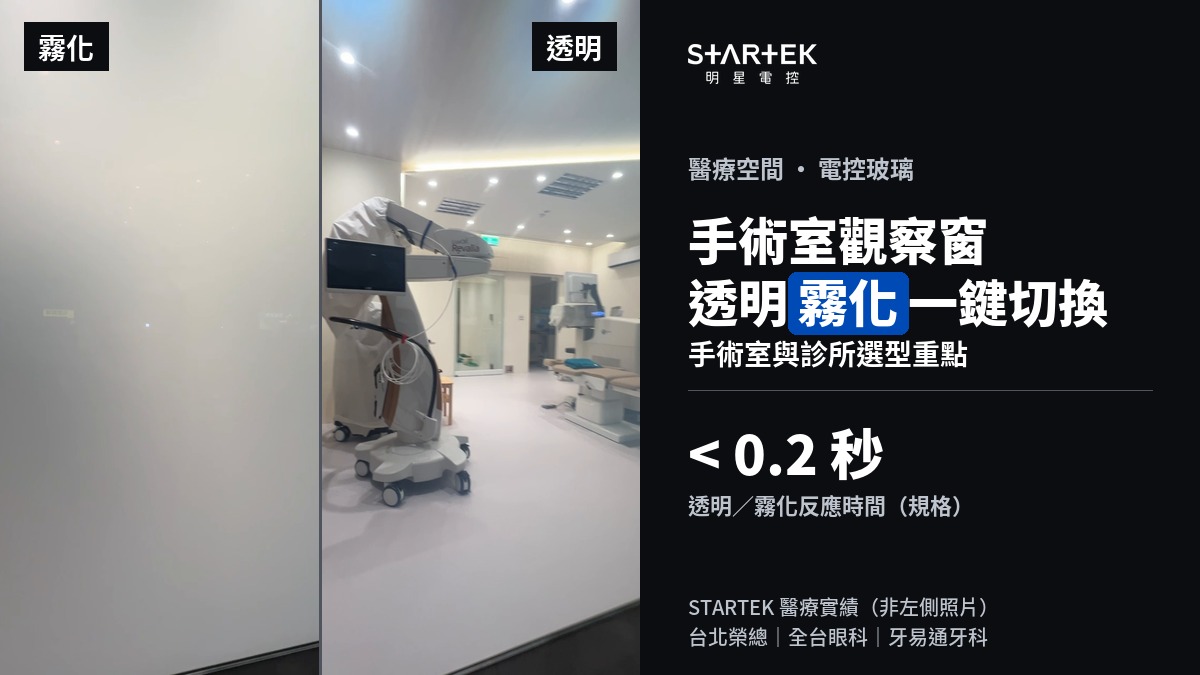
Planning switchable glass for a healthcare space comes down to three decisions: which locations need to switch between clear and frosted, whether to use factory-laminated glass for new construction or retrofit film on existing glass, and whether the glass should be clear or frosted when the power is off. STARTEK's standard PDLC smart glass is clear when powered and frosted when unpowered, and switches in under 0.2 seconds. For spots that must stay clear during an outage, STARTEK's Startek R turns clear when the power is off.
In a healthcare setting, one pane of glass often has two jobs. When staff need to observe, it has to be clear. During an exam or surgery, it has to block the view.
This guide walks through four planning questions: how to use it on operating room observation windows, where it makes sense in a clinic, which installation method fits new builds versus existing glass, and whether the glass should be clear or frosted when the power goes out.
▶ Watch the glass switch between clear and frosted: Switchable Smart Glass for Healthcare (YouTube)
Key Facts
- Standard PDLC smart glass switching time: frosted to clear on power-up <10 ms; clear to frosted on power-off <200 ms (under 0.2 seconds)
- Standard PDLC smart glass power consumption: 5 W/m² when powered
- Warranty: laminated switchable glass, 5 years standard with a paid extension up to 10; retrofit film, 3 years extendable to 5; Startek R, 1 year with no extension
- Power-off state: standard glass goes frosted; Startek R goes clear
Specifications and warranty information: STARTEK product specifications and product-specific warranty terms (2026).
Operating Room Observation Windows: Switching Between Clear and Frosted
Switchable glass lets staff choose between a clear view and visual privacy.
It puts both states in the same pane, switched with a remote:
- Clear: keeps the view open when staff need to observe
- Frosted: provides visual privacy during an exam or procedure
- Switching speed: under 0.2 seconds
Individual panes in a row of observation windows can be switched separately, depending on the wiring.
Planning Clinic Privacy Glass: Where Do You Need Switchable Privacy?
When planning spots like the partition between exam rooms and the waiting area or a glass exam-room door, consider which partitions and glass doors need to switch between clear and frosted. Before construction, work through three questions:
1. Will this pane be clear most of the time, or frosted?
Standard switchable glass is clear when powered and frosted when unpowered. The answer shapes the power-off decision below and whether Startek R is worth considering.
2. Which panes switch together, and which switch separately?
Every pane can be controlled independently, but the zones have to be set at the wiring stage. Mark which zone each pane belongs to on the floor plan so the wiring and controls can be planned around it.
3. Where do the power supply and service access go?
Switchable glass runs off a transformer. The 110V outlet and the transformer sit above a ceiling access panel, so plan space for both the equipment and service access.
Laminated Glass or Retrofit Film? Installation, Specs, and Warranty
New builds and existing glass call for different installation methods:
New build: laminated switchable glass
How it's made: laminated at the factory; on site, the crew only installs the glass
Warranty: 5-year standard warranty, with a paid extension up to 10 years
Best for: projects that are committed to switchable glass from the start
Existing glass: retrofit film
How it's done: film is applied pane by pane to the glass already on site
Warranty: 3 years, extendable to 5
Check first: site conditions, edge trim, and cleaning (see below)
Retrofitting existing glass works, but it isn't a one-size-fits-all fix. Confirm these installation requirements before placing an order:
- The site has to be clean and dust-free. If framing, carpentry, or painting isn't finished, or the dust hasn't been cleaned up, the film can't go on yet.
- The electrodes will be visible. A retrofit has no frame channel to hide them, so a matching-color edge trim that fully covers the roughly 1.5 cm electrode strip is required.
- Film comes in limited widths. A pane wider than the roll has to be spliced, leaving a seam about 5–7 mm wide that doesn't frost. Confirm where the seam goes up front.
- Cleaning: never spray water or cleaner directly on the glass. Spray a neutral cleaner onto a cloth and gently wipe the area that needs cleaning.
If budget or timing is tight, you can install ordinary glass now and add film later. Just plan for it in phase one: leave room for the wiring on the transformer's secondary side, the transformer and its service access, a 110V outlet, and the future edge trim.
For a full comparison of the two methods, see Laminated vs. Direct-Apply Switchable Film: A Complete Comparison.
Standard switchable glass switches in under 0.2 seconds and draws 5 W/m² when powered.
Clear or Frosted When the Power Is Off? Standard Glass vs. Startek R
This question is easy to miss when planning a healthcare space.
- Standard switchable glass: clear when powered, frosted when unpowered. During an outage, it goes frosted.
- Startek R: the opposite logic. Frosted when powered, clear when unpowered. During an outage, it turns clear automatically and doesn't block the view.
If certain locations need to stay see-through during a power outage, Startek R is worth a look. Keep in mind that Startek R carries a 1-year warranty with no extension option, which is different from laminated switchable glass, so compare them side by side.
STARTEK Healthcare Projects
- Taipei Veterans General Hospital: switchable glass installation
- Chuan-Tai Eye Clinic: switchable glass for the operating room
- Ya-Yi-Tong Dental Clinic: switchable glass for the operating room
To see how switchable glass shapes a clinic's space and brand, read Why More Medical Clinics Are Adopting Switchable Glass Partitions.
FAQ: Switchable Privacy Glass for Healthcare
Can switchable film be applied to a clinic's existing glass?
Yes, as a retrofit, but the site must be clean and dust-free, the exposed electrodes need edge trim, and any pane wider than the film roll will have a visible splice seam. It's best to confirm these before getting a quote.
Does switchable glass go clear or frosted when the power is off?
Standard switchable glass goes frosted. Startek R does the opposite and turns clear. For spots that need to stay see-through during an outage, consider Startek R.
Can I spray water on retrofit switchable film to clean it?
No. Don't spray water or cleaner directly on the glass, because liquid can seep in at the film edges, the electrode area, or a splice seam. Spray a neutral cleaner onto a cloth and gently wipe the area that needs cleaning.
How do the warranties compare for laminated glass, retrofit film, and Startek R?
Laminated switchable glass has a 5-year standard warranty, extendable to 10 years for a fee. Retrofit film is covered for 3 years, extendable to 5. Startek R has a 1-year warranty with no extension.
Planning a Healthcare Project? Start With These Three Things
Send STARTEK your floor plan, the size of each pane, and whether each location should normally be clear or frosted, and what it needs to do during an outage. We'll recommend an installation method and zoning based on your site.
Curious how pricing works? Read How Much Does Smart Glass Cost? 5 Easy Steps to Get a Quote.
Contact us: LINE | +886-2-7756-0773 | service@startektw.com
More applications: Smart Glass for Meeting Rooms (YouTube) and Meeting Room Glass With Projection
Related Articles
Latest Articles
-
PDLC vs Electrochromic vs SPD: How to Choose the Right Switchable Glass Technology
Smart Glass Revealed -
How Long Does PDLC Smart Glass Last? Durability Tests, Warranties, and Care
Smart Glass Revealed -
Retrofit PDLC Film or Laminated Switchable Glass? When Retrofit Film Works
Smart Glass Revealed


