Startek Switchable Glass: A Complete Comparison of Laminated vs. Direct-Apply Film—Building Smart Spaces That Combine Privacy and Design

Startek Switchable Glass: A Complete Comparison of Laminated vs. Direct-Apply Film-Building Smart Spaces That Combine Privacy and Design
When choosing switchable glass, many customers ask us the same question: "Should I go with the direct-apply film or the laminated product?" In reality, laminated and direct-apply switchable glass (switchable film) currently split the market roughly fifty-fifty. To understand which product fits which scenario, you have to take a close look at their structure and characteristics.
Below, Startek walks you through the differences, advantages, and ideal applications of these two types of switchable glass, helping you make the smartest choice.
1. Laminated Switchable Glass: Structure, Advantages, and High-Security Applications
Laminated switchable glass is a highly secure, structurally robust product.
Structure and Safety Characteristics
Laminated switchable glass is typically made with5mm + 5mm ultra-clear tempered glass, with a layer of liquid crystal switchable film (electrically controlled liquid crystal film) sandwiched in between. This assembly is produced under high heat and high pressure.
This manufacturing process gives the product the following key advantages:
- High security and hardness:A solid structure that delivers substantial hardness and structural safety.
- Excellent water resistance:Because the switchable film is completely sealed between the glass layers, the product is inherently waterproof.
- Sound insulation:Laminated glass also provides a degree of sound insulation in its own right.
Ideal Applications
Laminated switchable glass is exceptionally well suited to interior design and damp environments.
1. Residential and Interior Design Applications
During the residential design phase, if an elevation drawing already exists, customers simply need to provide the width and height, and we can estimate a quote for laminated switchable glass.
(See:How much does switchable glass actually cost?)
- Wet-area partitions:One of the most common uses for laminated switchable glass is in "damp areas." For example, it is frequently used for bathroom partitions, and can even be installed directly inside wet/dry separation areas.
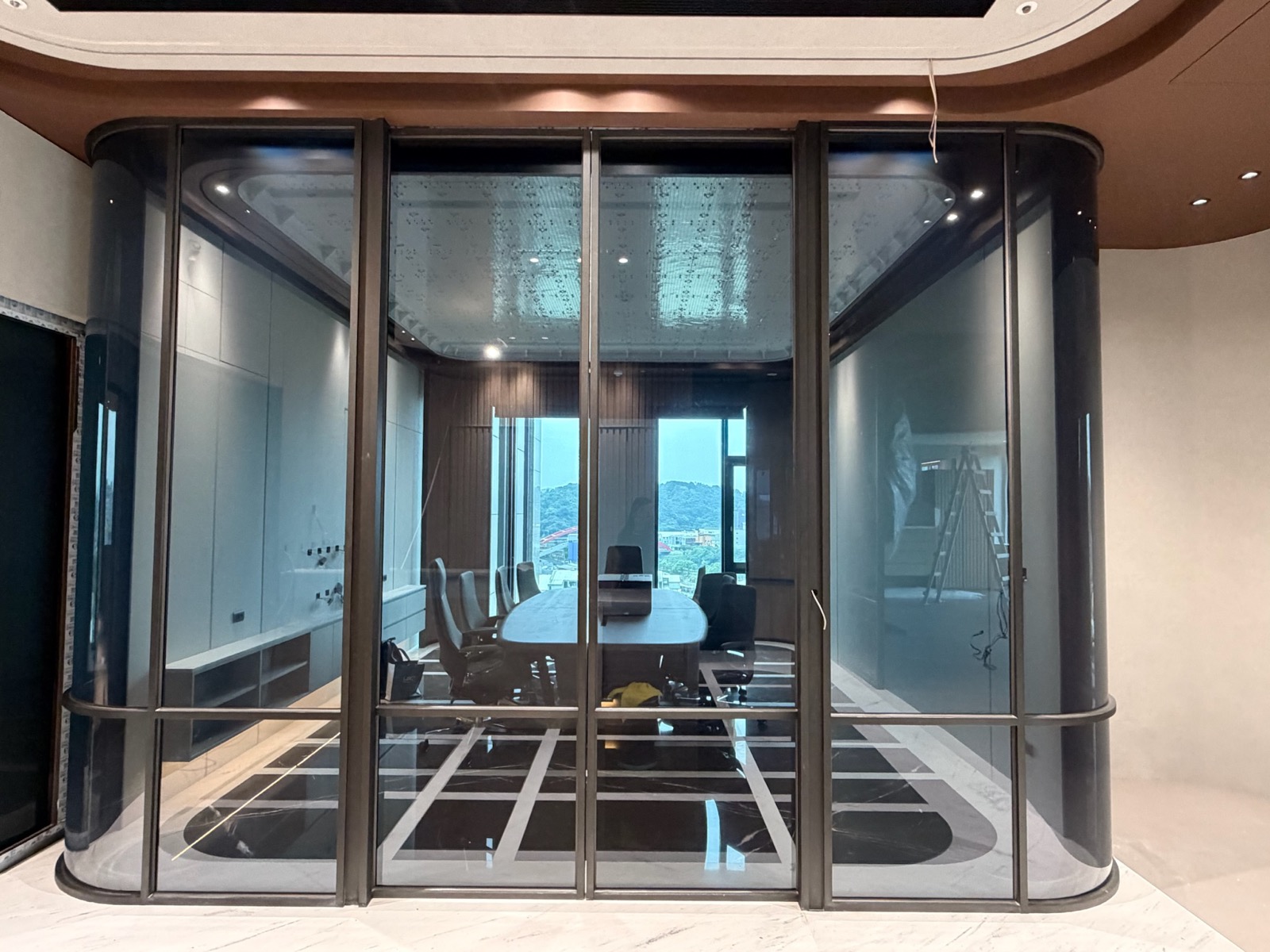
- Curved shapes:Laminated switchable glass can be made into curved, bent-and-laminated shapes. This kind of design is both beautiful and on-trend. That said, creating a curved shape requires attention to certain details, including a minimum diameter of 90 cm, as well as careful consideration of the electrode design for connecting the switchable glass to power.
2. Direct-Apply Switchable Glass (Film): The Top Choice for Upgrading Existing Glass
Direct-apply switchable glass, also known as switchable film, is primarily suited to scenarios where "you don't want to replace the existing glass."
Core Advantages and Use Cases
The core value of direct-apply film lies in its convenience and minimal impact on existing structures.
1. Building Exterior Windows and Privacy Considerations
Direct-apply switchable film is often used on a building's exterior-facing windows. In these settings, customers may face privacy concerns-for example, not wanting neighbors to see inside their home (especially when buildings are close together).
- No impact on appearance:Applying film does not affect the overall appearance of the building, so you can usually proceed with installation directly, without needing approval from the building management committee.
2. Large Windows and Cleaning Maintenance
For homes with very large windows-such as windows over 300 cm tall-direct-apply switchable glass can save a great deal of cleaning hassle and solve the heaviness that traditional curtains can introduce.
- Multiple benefits:Film easily delivers privacy, heat insulation, and light-blocking effects.
3. Selection Guide: Laminated vs. Direct-Apply Switchable Glass Comparison Table
4. A Startek Expert Reminder: Considerations for Wet-Area Applications
When evaluating switchable glass applications-especially in damp environments-you need to choose the product type carefully.
Limitations of Film in Wet Areas
If the bathroom in your home is a wet area where water splashes directly, please note that using direct-apply switchable film in this kind of environment can lead to"black-edge discoloration"if the edges are in prolonged contact with moisture.
Solutions for Bathroom Exterior Windows
If your bathroom has an exterior window and you want switchable functionality, we do not recommend applying film directly. To ensure long-term appearance and service life, we recommend the following approach:
- Replace the existing glass:Simply swap out the original glass.
- Use a laminated product:Install laminated switchable glass on the window.
Both of these approaches will keep the overall appearance looking great for a long time.
Conclusion and Initial Assessment Service
Whether you want stylish curved switchable glass in your home study, or one-touch privacy for the exterior windows of a high-rise, choosing the right type of switchable glass is the key to success.
In summary, laminated and direct-apply switchable glass each have their own scenarios and advantages. If you would like to assess which product is right for your project, please be sure to provide yourwidth and height (dimensions), and we will be able to give you an initial assessment and quote.
If you have any further questions, or need to consult on details such as curved designs, feel free to reach out to us through our official LINE account for more detailed service.
One-on-one personal service (click here)
Explore different product applications (click here)
Related Articles


Latest Articles
-
PDLC vs Electrochromic vs SPD: How to Choose the Right Switchable Glass Technology
Smart Glass Revealed -
How Long Does PDLC Smart Glass Last? Durability Tests, Warranties, and Care
Smart Glass Revealed -
Retrofit PDLC Film or Laminated Switchable Glass? When Retrofit Film Works
Smart Glass Revealed