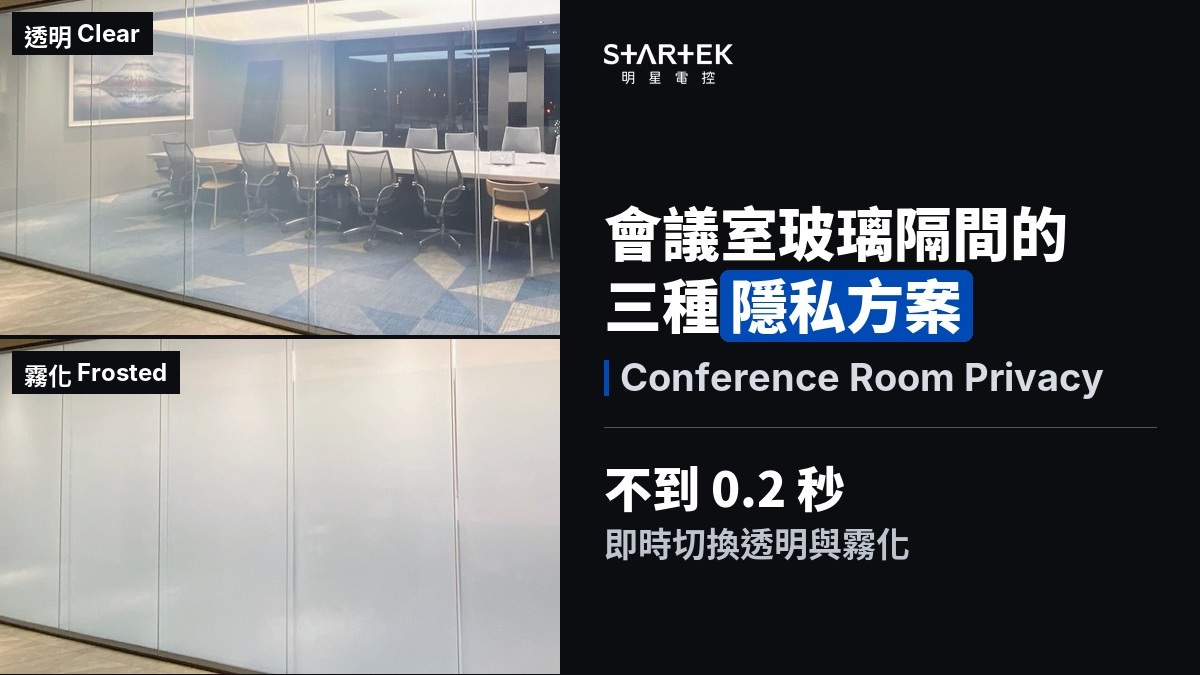
Conference Room Privacy: Blinds vs Frosted Film vs PDLC Switchable Glass — A Designer's Comparison
Glass partitions make offices feel open and bright, but conference rooms need privacy — client presentations, HR interviews, executive meetings should not be visible to everyone walking by. The challenge for designers: how do you switch between "open and transparent" and "completely private"? This guide compares the three most common solutions, written for designers to share directly with their clients. STARTEK is a Taiwan-based PDLC switchable glass specialist, focused on privacy solutions for architectural spaces.
Key Facts
- Blinds offer adjustable light control but obstruct views, collect dust, and risk mechanical failure
- Frosted film provides permanent privacy with no ability to switch back to transparent
- PDLC switchable glass switches between transparent and frosted in under 0.2 seconds, maintaining the clean lines of glass partitions
- STARTEK laminated switchable glass: 5-year standard warranty (included), extendable to 10 years
- Power consumption: approximately 5 W/m²; frosted state uses zero power
Option 1: Blinds — Traditional Solution, Features and Limitations
Blinds (including integrated blinds within insulated glass units) are the most common conference room privacy solution. The advantages are intuitive — adjustable angle control and straightforward pricing.
In office environments, blinds come with practical considerations:
- Dust accumulation: Horizontal slats collect dust and require regular cleaning. Integrated blinds inside sealed glass units cannot be cleaned once dust enters.
- Mechanical failure: Pull cords fray, tilt mechanisms jam, and slats misalign over time. Integrated magnetic controls can fail, typically requiring full-unit replacement.
- Visual clutter: Closed blinds replace the clean transparency of glass with a wall of horizontal or vertical slats, breaking the open-design aesthetic that glass partitions are meant to deliver.
- Binary states: Blinds offer open, closed, or half-open — they cannot create a uniform frosted effect that still transmits light.
Blinds remain a practical budget option, but they carry ongoing maintenance costs and design compromises.
Option 2: Frosted Film — Simple, but Permanent
Frosted window film (or sandblast-effect film) is another common approach — apply it to the glass and the conference room has permanent translucent privacy.
It is simple, affordable, and requires no power. But the limitation is fundamental:
- No switching: Once applied, it stays frosted. The conference room loses the transparent, open feel of glass even when privacy is not needed.
- Design compromise: Frosted film is typically applied to a partial height (waist-level or eye-level), creating a "half-and-half" appearance that is less refined than either full transparency or full frosting.
- Aging: Lower-quality films may develop bubbles or edge peeling after several years.
Frosted film is ideal for spaces that will never need transparency — bathroom doors, permanently private areas. But for conference rooms that need both open and private modes, its permanence is the drawback.
Option 3: PDLC Switchable Glass — Instant Switching, Both States in One
PDLC switchable glass excels at switching between transparent and uniformly frosted states. One tap on a switch, remote, or smartphone app — in under 0.2 seconds, the entire glass surface goes from clear to private.
From a designer's perspective, it solves what the other two cannot:
- Transparent by default, private on demand: When the room is not in use, it maintains the openness of glass. When privacy is needed, one tap switches it.
- Minimalist aesthetic: No slats, no cords, no partial films — the glass stays clean. Frosted mode is a uniform white that looks cleaner than closed blinds.
- Fail-safe privacy: PDLC glass defaults to frosted when power is off. During power outages, conference rooms automatically enter privacy mode.
- Minimal power: Approximately 5 W/m². Schedule automatic power-off during unoccupied hours; the frosted state uses no energy.
- Smart integration: Combine with access control, occupancy sensors, or room booking systems for fully automated operation — booked meeting triggers transparent; session ends triggers frosted.
STARTEK offers both laminated and retrofit installation. For new construction, laminated glass (5+5 mm tempered glass with film sandwiched) is recommended — factory-finished quality with a 5-year standard warranty (included), extendable to 10 years. For existing glass partitions, retrofit PDLC film can be applied without removing the current glass.
Quick Comparison
Switching Flexibility
- Blinds: Adjustable angles; manual or motorized operation
- Frosted film: No switching; permanently fixed
- PDLC switchable glass: Under 0.2 seconds; compatible with smart controls
Privacy Performance
- Blinds: Effective when closed, but gaps between slats remain
- Frosted film: Fixed translucent privacy
- PDLC switchable glass: Uniform frosted opacity; effective visual privacy (objects pressed within ~10 cm may show faint outlines)
Maintenance
- Blinds: Regular slat cleaning required; mechanical failure risk
- Frosted film: Essentially maintenance-free; potential aging issues
- PDLC switchable glass: Same surface as regular glass; standard cleaning
Design Aesthetics
- Blinds: Closed state disrupts glass transparency
- Frosted film: Partial application creates a compromised look
- PDLC switchable glass: Clean minimalist appearance in both states
Installation Requirements
- Blinds: Track or frame mounting required
- Frosted film: Direct application; simple installation
- PDLC switchable glass: Laminated for new builds; retrofit for existing glass; power source required
Which Option Fits Your Conference Room?
- Limited budget, short-term solution: Blinds are the fastest answer
- Permanent privacy, no need for transparency: Frosted film is the most economical
- Freedom to switch between open and private, with design integrity: PDLC switchable glass is the complete solution
For designers, PDLC switchable glass means you no longer have to choose between openness and privacy — the same glass delivers both experiences. This is why an increasing number of commercial offices, healthcare facilities, and hospitality spaces are specifying switchable glass as a standard feature.
STARTEK delivers design support, fabrication, on-site installation, and after-sales warranty as a complete package.
FAQ
Q1: Which provides better privacy — switchable glass or blinds?
PDLC switchable glass creates a uniform frosted surface — interior details are not easily visible (objects pressed within about 10 cm of the glass may show faint outlines; maintaining distance behind the glass improves the effect). Closed blinds have gaps between slats and can be seen through at certain angles. For consistent privacy across the entire glass surface, switchable glass provides more uniform coverage.
Q2: Can existing glass partitions be upgraded to switchable glass without demolition?
Yes. STARTEK offers retrofit installation — PDLC film is applied directly to existing glass without removing the current partition. Retrofit requires a pre-installed power line and an on-site assessment. Retrofit film carries a 3-year standard warranty, extendable to 5 years.
Q3: What happens to switchable glass during a power outage?
PDLC switchable glass automatically frosts when power is cut. For conference rooms, this is a fail-safe feature — the room automatically enters privacy mode during outages without any manual intervention.
Q4: Does switchable glass require special maintenance?
Laminated switchable glass has the same surface as regular glass — standard cleaning applies. Retrofit film requires careful cleaning — do not spray liquids directly on the glass surface; apply neutral cleaner to a cloth and wipe.
Q5: How long does PDLC switchable glass last?
Testing by the Energy Technology and Strategy Research Center at National Cheng Kung University, conducted per GB/T 35847-2018, showed that after 80,000 switching cycles, light transmittance decreased by only 0.29% (the standard allows up to 3%). This corresponds to over 10 years of typical daily usage intensity. STARTEK laminated glass carries a 5-year standard warranty (included), extendable to 10 years.
Planning switchable glass for your conference room or office?
Related Articles
Latest Articles
-
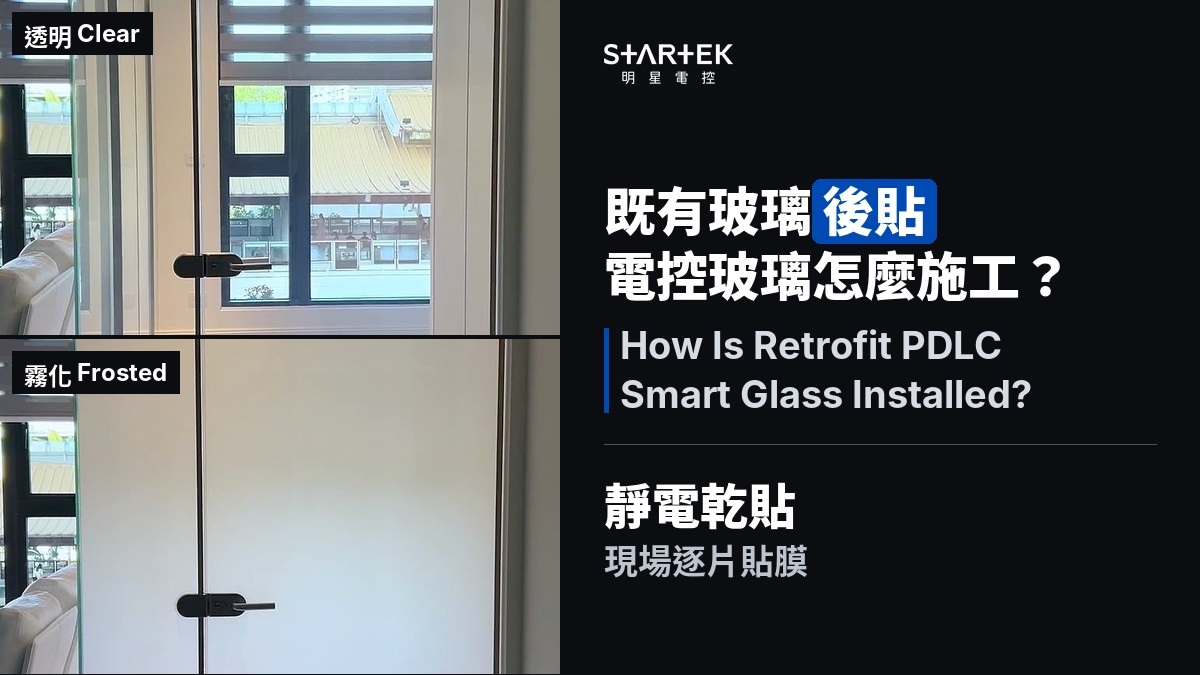
How Is Retrofit PDLC Smart Glass Installed? The Process from Survey to Handover
Smart Glass Revealed -
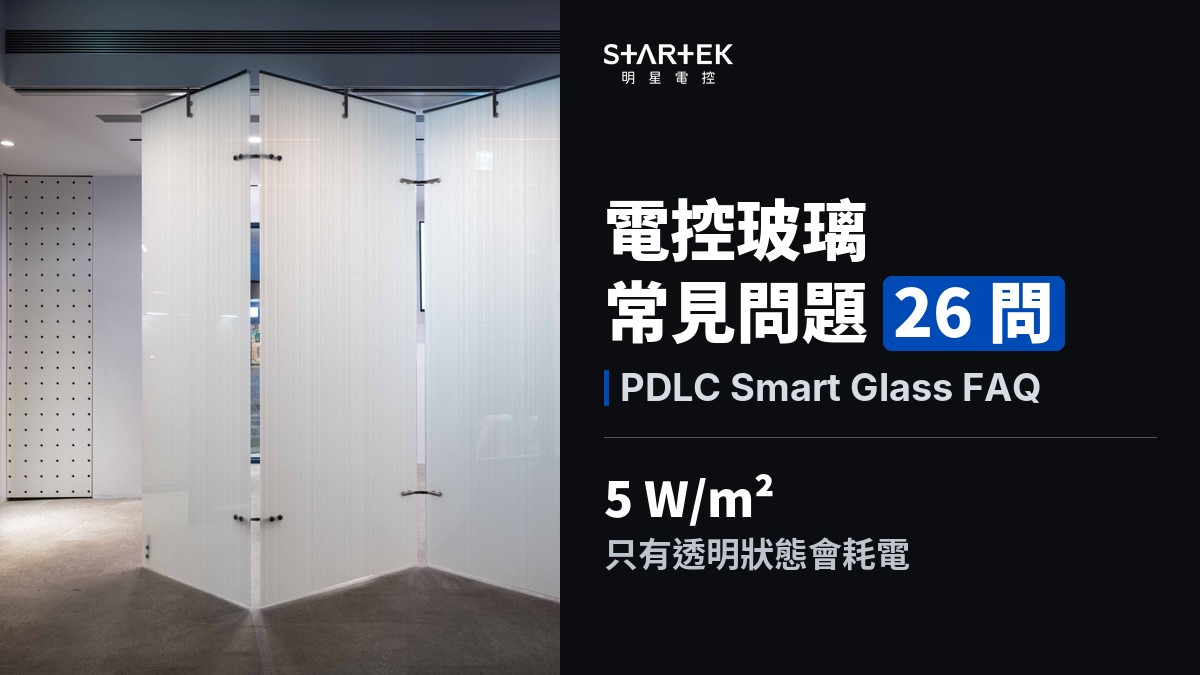
PDLC Smart Glass FAQ: 26 Questions Answered
Smart Glass Revealed -
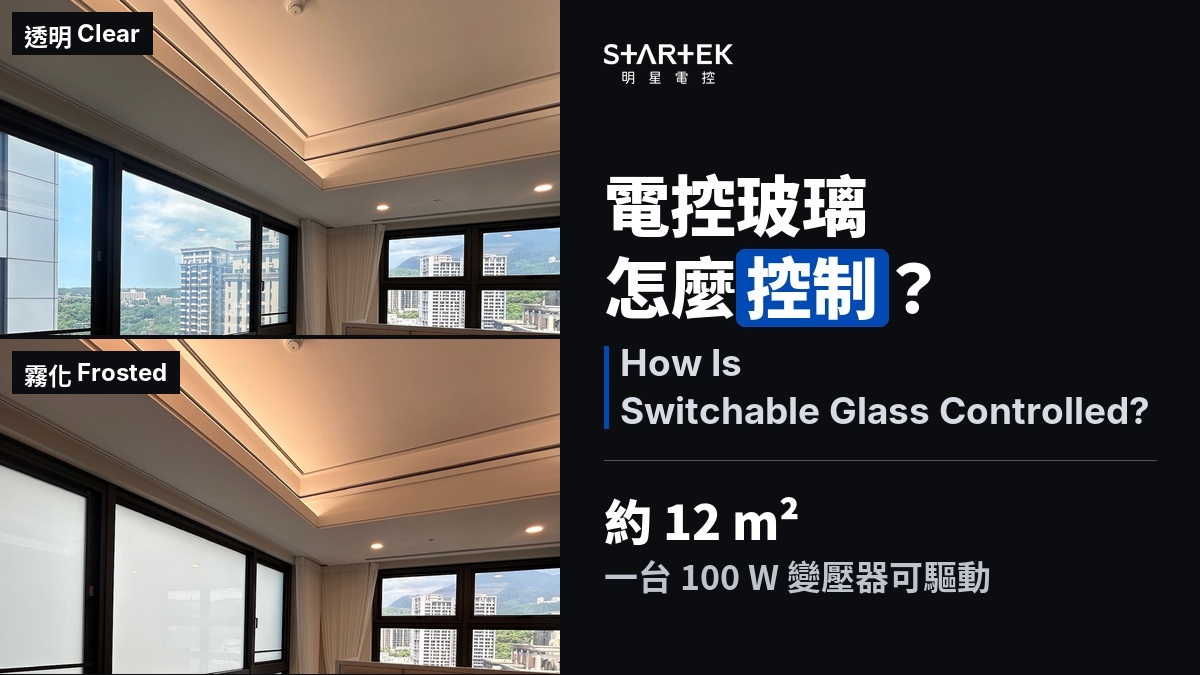
How Is Switchable Glass Controlled? Remotes, Zoning, and Scheduling Essentials
Smart Glass Revealed