How Is Retrofit PDLC Smart Glass Installed? The Process from Survey to Handover
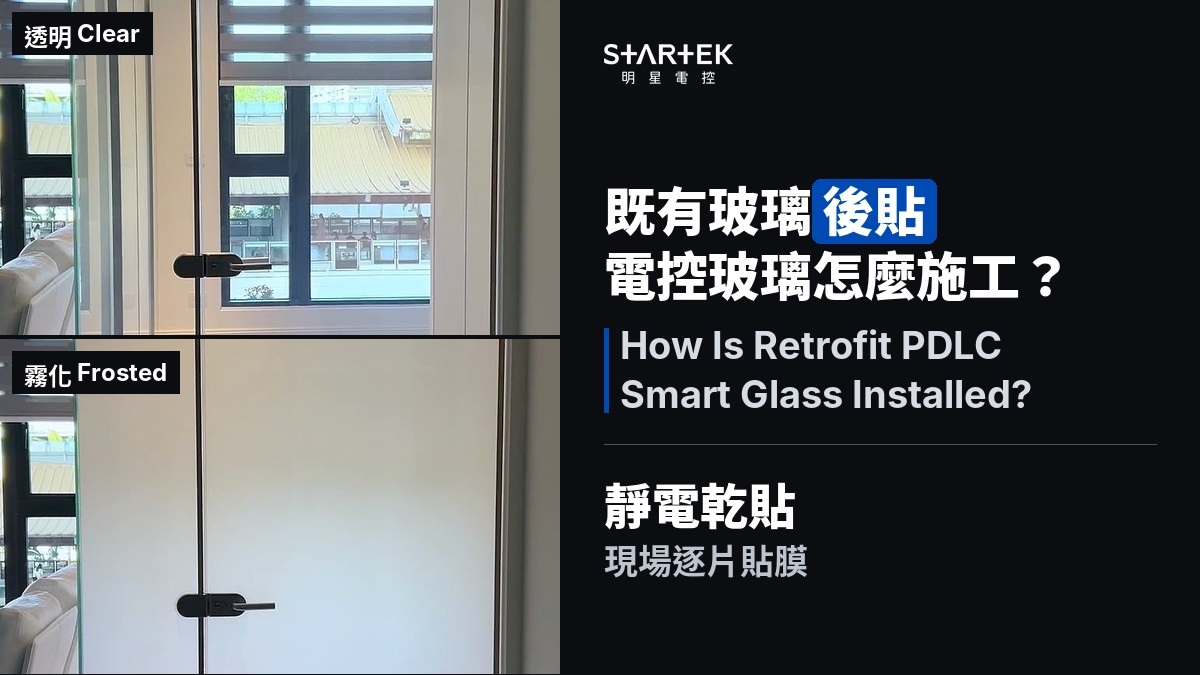
Your office already has glass partitions, and the client wants privacy without tearing them out — this is one of the most common requests we receive. STARTEK's self-adhesive PDLC film can be applied to existing glass, adding instant clear-to-frosted switching without replacing the glass itself. But retrofit is not just "stick it on." There is a full process from site survey to handover, and each step affects the final result. This article explains the six stages so designers and building owners know what to prepare before signing a contract. STARTEK is a Taiwan-based PDLC switchable glass specialist offering survey, design, installation, and warranty as a one-stop service.
Key Facts
- Retrofit installation uses static dry-bond adhesion, applied pane by pane on site (product: STARTEK self-adhesive PDLC film)
- The site must be clean and dust-free — carpentry and painting must be finished first (see Retrofit PDLC Film or Laminated Switchable Glass?)
- Retrofit bus bars sit exposed on the glass surface, so edge trim (color-matched, wide enough to fully cover the roughly 1.5 cm electrode strip) is a required component, not optional
- Before installation, the STARTEK site survey report confirms bus-bar position and wiring route for each pane — once the film is on, these cannot be changed
- Wiring runs on the surface to connect to the transformer and a 110V outlet; the route must be assessed in advance
- At handover, the cleaning rule must be communicated: never spray liquid directly on the glass surface
- The film can be removed without residue and without damaging the original glass — but removed film picks up dust and cannot be re-applied, either to the same glass or to other glass
- For the retrofit (direct-apply) warranty term and paid extension, see the warranty section of How Long Does PDLC Smart Glass Last?
Specification and warranty source: STARTEK product specifications and warranty table by product (2026)
The Six Stages at a Glance
| Stage | Focus | Outcome |
|---|---|---|
| 1. Site survey | Glass condition, wiring route, transformer location | Site survey and design recommendation report |
| 2. Design confirmation | Bus bars, wiring, and zones confirmed pane by pane | No changes after installation |
| 3. Site preparation | Dusty trades finished, site cleaned | Ready for film application |
| 4. Film application | Static dry bond, edge trim, surface wiring | All panes applied |
| 5. Testing and acceptance | Switching and remote pairing checked pane by pane | Warranty starts |
| 6. Handover | Cleaning rule given in writing | Handed to the owner |
1. Site Survey: Assessing the Glass and Environment
The first step is an on-site survey. STARTEK technicians check:
- Condition, dimensions, thickness, and mounting of the existing glass
- Whether the glass surface has coatings, films, or scratches that could affect adhesion
- Wiring route: retrofit requires surface-mounted wiring from the glass edge to the transformer and 110V outlet
- Transformer placement and access panel location
- Site conditions: whether the space can be kept clean and dust-free during installation
After the survey, STARTEK issues a Site Survey and Design Recommendation Report, marking bus-bar positions in red and secondary wiring routes in blue. This report is the design blueprint for the entire installation.
For the points to settle before the survey, see the installation guide: retrofitting PDLC film on existing glass.
2. Design Confirmation: Finalize Each Pane — No Changes After Installation
With the report in hand, STARTEK confirms with the designer and building owner pane by pane:
- Bus-bar position on each pane (determines edge trim placement)
- Wiring route and transformer configuration
- Zone control logic: which panes switch together, which switch independently
This step is critical because once the film is applied, bus-bar positions and wiring cannot be changed. Any revision after installation means removing the film and installing new film — removed film cannot be reused.
3. Site Preparation: Clean and Dust-Free Is Non-Negotiable
Retrofit film must be applied on a clean, dust-free site: carpentry, painting, and other dusty work must be finished and the area cleaned before installation starts. For how to judge site conditions and when retrofit is not a good fit, see Retrofit PDLC Film or Laminated Switchable Glass?.
4. Film Application: Static Dry Bond, Pane by Pane
STARTEK self-adhesive PDLC film uses static dry-bond adhesion. Technicians apply the film to each pane on site. Key points:
- Edge trim is mandatory: with no frame channel to conceal the bus bars, a color-matched edge trim fully covers the roughly 1.5 cm electrode strip along the film edge. Color and material are confirmed at the quotation stage.
- Width limit: PDLC film comes in rolls with a maximum width. If a single pane exceeds the film width, a splice is needed, leaving a visible seam of about 5–7 mm (does not frost, transmits light). Splice positions require written consent from the building owner during the design stage.
- Surface-mounted wiring: secondary wiring runs from the glass edge to the transformer and 110V outlet. The route was confirmed in the survey report.
5. Testing and Acceptance: Verify Every Pane
After film application and wiring, each pane is tested on site:
- Clear-to-frosted switching on every pane
- Remote control pairing and zone control accuracy
- Edge trim alignment and wiring tidiness
Warranty coverage begins on the acceptance date.
6. Handover: The Cleaning Rule Is Mandatory
One non-negotiable rule must be communicated to the building owner and cleaning staff at handover:
- Never spray water, mist, or any cleaning or maintenance product directly on the glass surface.
- To clean, spray a neutral cleaner (such as Windex) onto a cleaning cloth, then wipe locally.
- Never spray the entire surface — liquid can seep through film edges, bus-bar areas, and splice seams, damaging the liquid crystal film.
Provide this rule in writing to the owner and cleaning staff at handover.
Note: Retrofit Film Is Removable — Suitable for Leased Offices
STARTEK self-adhesive PDLC film can be removed without leaving residue. For leased office spaces, the film can be removed when vacating without damaging the original glass, which makes retrofit a flexible option for tenants. Note, however, that removed film picks up dust and cannot be re-applied — not to the same glass and not to other glass. A new space needs a new installation.
FAQ
Q1: How long does retrofit installation take?
Installation time depends on the number of panes and site conditions. It takes longer on site than laminated glass (which is factory-assembled and only requires glass installation on site). A specific timeline is provided after the site survey.
Q2: What types of glass can be retrofitted?
Most flat glass can be assessed; curved glass cannot take direct-apply film. Coatings, scratches, or uneven surfaces affect adhesion, so a site survey is required. See Retrofit PDLC Film or Laminated Switchable Glass? for the criteria.
Q3: Can the edge trim color be chosen?
Yes. Edge trim comes in color-matched options. Color and material are confirmed at the quotation stage and installed uniformly.
Q4: What is the warranty for retrofit smart glass?
The warranty starts from the acceptance date. For the retrofit (direct-apply) warranty term and paid extension, see How Long Does PDLC Smart Glass Last?.
Q5: Is the splice seam noticeable?
When the glass width exceeds the film width, a splice is needed. The seam is about 5–7 mm wide and does not frost — it transmits light when the rest of the glass is frosted. Splice positions are confirmed with the building owner during the design stage, with written consent.
Q6: Can we peel the film off and take it to our new office?
No. The film can be removed without residue and without damaging the original glass, but removed film picks up a lot of dust and cannot be re-applied to the same glass or to other glass. A new space needs a new installation.
Want to assess whether your existing glass is suitable for retrofit smart glass?
Related Articles
Latest Articles
-
How Is Retrofit PDLC Smart Glass Installed? The Process from Survey to Handover
Smart Glass Revealed -
PDLC Smart Glass FAQ: 26 Questions Answered
Smart Glass Revealed -
How Is Switchable Glass Controlled? Remotes, Zoning, and Scheduling Essentials
Smart Glass Revealed