How Big Can Switchable Glass Go? Width Limits, Panel Splitting, and Delivery Constraints
When designing large conference room walls or full-height office partitions, architects often ask: how big can PDLC switchable glass panels actually be, and will there be visible seams? This article covers the width limits of PDLC switchable glass, the logic behind panel splitting, and the delivery check that should come before any sizing decision. STARTEK is a Taiwan-based PDLC switchable glass specialist offering both laminated and retrofit installation options.
Key Facts
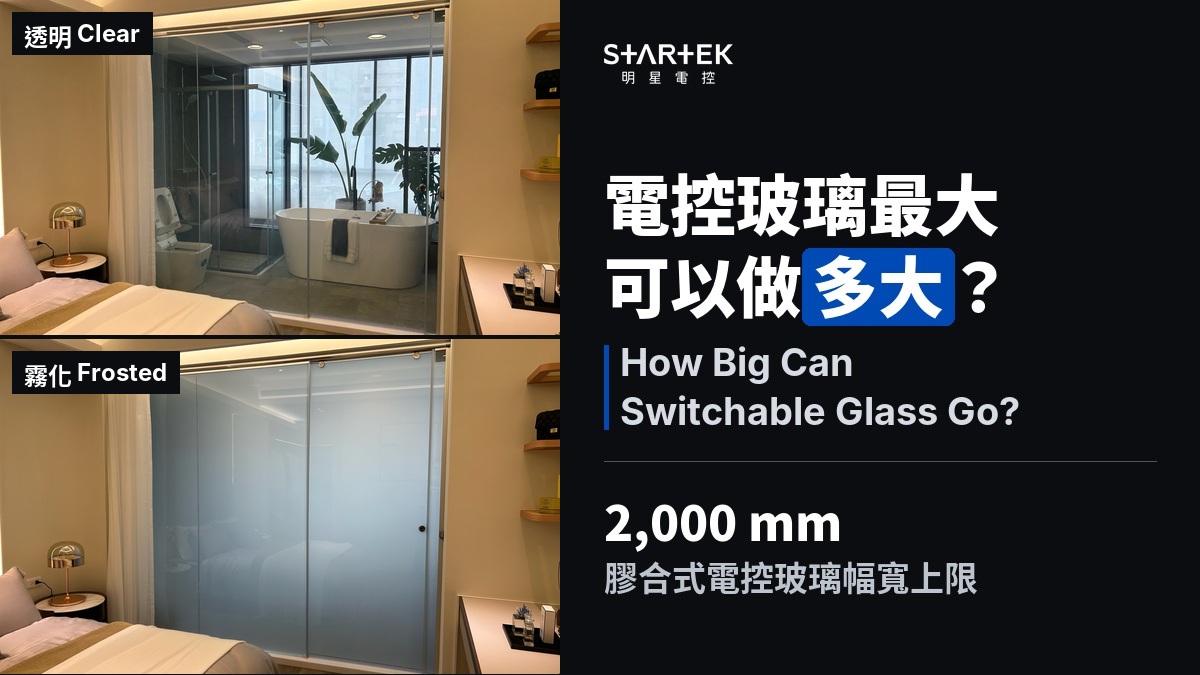
- Laminated switchable glass: maximum width 2,000 mm, no fixed length limit (applies to: all STARTEK laminated products)
- Self-adhesive PDLC film: maximum width 1,800 mm (applies to: all STARTEK retrofit products)
- Panels wider than the film require a splice, leaving a visible seam of approximately 5–7 mm that does not frost
- Length is unlimited in theory — check the elevator and delivery route first, then decide on panel sizes
- Curved panels: minimum bending radius R450 (R45 cm)
- STARTEK laminated switchable glass: 5-year standard warranty (included), extendable to 10 years
Width Limits: Laminated vs Retrofit
PDLC film comes in rolls with a fixed width. The two installation methods have different width limits:
- Laminated: up to 2,000 mm wide, no fixed length limit. The PDLC film is sandwiched between two glass panes in the factory; glass length can be customized to the design.
- Retrofit (self-adhesive): up to 1,800 mm wide. The film's own roll width is the constraint.
"Width" here refers to the narrower dimension of the film. If the glass panel fits within the width limit, it uses a single piece of film with no seam.
Beyond the Width Limit: Splicing
When a single glass panel exceeds the film width, two pieces of film are joined — a splice. The splice leaves a seam approximately 5–7 mm wide with two characteristics:
1. It does not frost: when the glass is frosted, the splice line remains transparent.
2. It transmits light: from outside, the frosted glass shows a thin, clear line.
The splice position should be confirmed with the client during the quotation stage, with written approval. Designers can align splices with frame divisions or spatial boundaries so they read as intentional.
No Fixed Length Limit — but Check the Elevator First
Laminated switchable glass has no fixed length limit — but that does not mean any length is feasible. In practice, the constraint is usually not manufacturing but delivery.
The correct sequence for large switchable glass panels:
1. Measure the elevator and every segment of the delivery route — from the factory truck to the installation position, including elevator dimensions, corridor widths, stairwell turns, and door openings.
2. Then decide on panel sizes — once you know the largest panel that can physically reach the room, decide whether and how to split.
Do not finalize the panel layout first and then check whether the pieces can be delivered. If the elevator accepts a maximum of 2,400 mm, any panel longer than that must be split regardless of the design intent.
Curved Panels
Switchable glass can be curved — produced as bent, tempered laminated glass (5+5 mm). Constraints:
- Minimum bending radius: R450 (R45 cm). If the design calls for a tighter curve, it must be adjusted to R450, with the tangent lines on both sides revised accordingly.
- Curved panels are laminated only — retrofit film cannot be applied to curved glass.
FAQ
Q1: What is the maximum size for switchable glass?
Laminated: up to 2,000 mm wide with no fixed length limit. Retrofit film: up to 1,800 mm wide. The actual maximum depends on the elevator and delivery path at the project site.
Q2: Is the splice seam very noticeable?
The splice is approximately 5–7 mm wide and appears as a thin, clear line when the glass is frosted. Plan the splice position during the design phase to align with frame divisions or spatial boundaries.
Q3: Can switchable glass cover an entire wall without a seam?
Yes, as long as the panel width stays within the film limit (laminated: 2,000 mm; retrofit: 1,800 mm). The length direction is not constrained by the film, but delivery access must be verified.
Q4: Does a large switchable glass panel use a lot of power?
PDLC switchable glass consumes approximately 5 W/m², proportional to area. A 2,000 × 3,000 mm (6 m²) laminated panel draws about 30 W when clear; it uses no power when frosted.
Q5: How tight a curve can switchable glass achieve?
The minimum bending radius is R450 (R45 cm), produced as laminated glass. Tighter curves cannot be achieved with switchable glass and require a design revision to square corners or a larger radius.
Want to know what panel sizes work for your space?
Latest Articles
-
How Is Retrofit PDLC Smart Glass Installed? The Process from Survey to Handover
Smart Glass Revealed